
The Genesis: Why “Revolution” and Why Now?
The term “Revolution” is not used lightly. Traditionally, the energy sector has been one of the most centralized industries in human history. For over a century, the model was simple: a massive power plant burns coal, gas, or splits atoms; the power is sent over hundreds of miles of wire; and the consumer pays whatever price the utility company dictates.
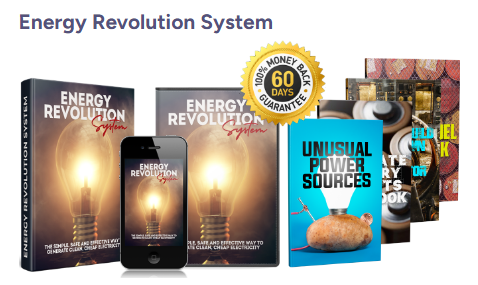
The Energy Revolution System (ERS) enters this space as a disruptive idea. It isn’t just a set of instructions; it is a response to the “Conversions Monster”—the inefficiency inherent in converting raw energy into usable household electricity. By focusing on localized, small-scale generation and efficiency, the ERS aims to move the “power” from the utility board back to the individual.
The Core Technology: The Bifilar Pancake Coil
At the heart of the ERS is a specific component that separates it from standard magnetic or solar generators: the Bifilar Pancake Coil.
The Tesla Connection
In 1894, Nikola Tesla patented a unique coil design (U.S. Patent 512,340). Unlike a standard solenoid coil where the wire is wound in a single direction around a core, the bifilar coil is wound with two strands of wire in parallel. These strands are then connected in series so that the current flows in the same direction in both.
How it Works
The ERS leverages the unique properties of this coil:
-
Reduced Self-Inductance: Because of the way the wires are wound, the coil’s self-inductance is minimized, allowing it to respond faster to electromagnetic changes.
-
Increased Capacitance: The two parallel wires act like the plates of a capacitor, allowing the coil to store an electrostatic charge within its own windings.
-
Resonance: When paired with a specific frequency (often achieved through a small initial power input or “trigger”), the coil enters a state of resonance. In this state, the ERS claims to “capture” ambient electromagnetic energy or amplify the efficiency of the input current, significantly reducing the “waste” usually seen in electrical systems.
The “Conversions Monster” Explained
Marketing materials often refer to the “Conversions Monster.” This is a metaphorical representation of the energy loss that occurs during traditional power transmission and conversion.
-
Generation Loss: Heat loss at the power plant.
-
Transmission Loss: Resistance in the miles of copper wire between the plant and your home.
-
Appliance Inefficiency: The “hum” and heat your refrigerator or AC unit produces is essentially wasted money.
The ERS focuses on efficient conversion. By generating power at the point of use and using resonant coils, it attempts to “tame” the monster by ensuring that more of the energy actually does work rather than dissipating as heat.
Building the System: A DIY Blueprint
Unlike a solar panel kit that arrives in a crate, the Energy Revolution System is a digital guide. It empowers the user to source their own materials, which the creators claim keeps costs low (typically between $70 and $200).
Necessary Components
-
Copper Magnet Wire: The lifeblood of the bifilar coil.
-
Neodymium Magnets: Used to create the initial magnetic flux.
-
Capacitors and Diodes: For storing and “rectifying” (straightening) the current.
-
A Solid Base: Often wood or non-conductive plastic to house the components.
-
Simple Tools: A soldering iron, wire strippers, and a multimeter.
The Assembly Process
The guide takes a modular approach. First, the user winds the bifilar pancake coil—a process that requires patience but no advanced engineering degree. Next, the magnetic array is positioned to interact with the coil’s field. Finally, the circuitry is connected to stabilize the output so it can safely power devices like LED lights, routers, and small appliances.
Performance Expectations vs. Reality
One of the most critical parts of this “Energy Revolution” is managing expectations. While the marketing suggests an 80% reduction in bills, real-world application often tells a more nuanced story.
What it Can Power
-
Small Loads: LED lighting, phone chargers, laptop adapters, and Wi-Fi routers are the most successful applications.
-
Medium Loads: With scaling and additional coils, users have reported success in supplementing the power needs of refrigerators or fans.
-
The “Slowing the Meter” Effect: Rather than replacing the grid, the ERS is often used to “offload” specific circuits. If your lights and internet are running on the ERS, your utility meter spins slower, leading to the promised savings over time.
The Psychological Revolution: Self-Reliance
Perhaps the most lasting impact of the Energy Revolution System isn’t the electricity it generates, but the awareness it builds.
When a homeowner builds a generator from scratch, they stop seeing electricity as a “magic fluid” and start seeing it as a resource they can manage. This “Psychological Revolution” leads to:
-
Better Usage Habits: Knowing how much effort goes into generating a watt makes you less likely to leave the lights on.
-
Disaster Preparedness: Having a portable, fuel-less source of power is invaluable during grid failures or natural disasters.
-
Educational Value: Many users report building the system with their children as a way to teach physics and sustainability.
Critiques and Skepticism
No “Revolution” exists without opposition. Critics often point out that “free energy” violates the Second Law of Thermodynamics. However, the ERS proponents argue that the system isn’t “creating” energy from nothing, but rather harvesting existing ambient fields or optimizing current flow through resonance—concepts that find some support in the fringe and historical works of inventors like Tesla and Bedini.
From a practical standpoint, the biggest “scam” complaints usually stem from users who expect the system to power a central AC unit for a 5,000-square-foot home immediately after a two-hour build. The ERS is a supplemental tool, not a magic box.
Financial Analysis: The ROI of the ERS
Is it worth the investment?
-
Initial Cost: ~$50 (Digital Guide) + ~$100 (Materials) = $150.
-
Monthly Savings: If a household saves $30 a month on their bill, the system pays for itself in 5 months.
-
Longevity: With no moving parts (in the solid-state versions), the system can theoretically last for years with minimal maintenance.
Compared to a $15,000 solar installation, the ERS offers a much lower barrier to entry for those looking to start their journey toward energy independence.
Conclusion: The Future of the Energy Revolution
The Energy Revolution System – Conversions Monster is more than a product; it is a symptom of a world looking for alternatives. Whether it achieves the full 80% savings for every user is secondary to the fact that it makes energy generation accessible to the average person.
In the 21st century, the real “monster” is the feeling of helplessness against rising costs and decaying infrastructure. By picking up a copper wire and a set of blueprints, the participants in this revolution are taking their first steps toward a more resilient, self-sufficient future.
Quick Specs for the ERS
| Category | Details |
| Creator | Michael Garnett (Energy Enthusiast) |
| Tech Base | Nikola Tesla’s Bifilar Pancake Coil |
| Primary Goal | 50% – 80% Electricity Bill Reduction |
| Difficulty | Beginner to Intermediate DIY |
| Material Cost | $70 – $200 (Sourced locally) |
| Refund Policy | 60-Day Money Back Guarantee |

Reviews
There are no reviews yet.